
Malick Sidibé - 22/03/2026

Malick Sidibé (1935–2016) was born in the village of Soloba, far from the capital of Mali, and came to photography through years of learning, starting as a decorator and printmaker before finding his own vision behind the lens. What grew from that quiet beginning became one of the most alive and generous bodies of work in the history of photography.
His images carry something essential: not just a record of a moment, but a record of how people chose to present themselves, to move, to celebrate, to be seen. Identity expressed through presence, through clothing, through gesture and posture. Sidibé captured all of it, and he captured it with love.

Style, Freedom & The Archive of a Generation
Much of Sidibé's work documented an important turning point as Mali moved from French colony to independent nation. He played a quiet but significant role in shaping how a new generation chose to see itself. That expression came through in fashion, music and dance, and his photographs made all of it visible and lasting.
What stands out most is how willingly and proudly his subjects showed up. In his studio portraits, he captured the changing styles and ambitions of a generation. Patterned backdrops that either matched or playfully contrasted with his subjects' outfits and poses. People brought their motorcycles, their James Brown records, their finest clothes. They came to be seen, and Sidibé honoured that completely.
A community building its own image, on its own terms, and someone skilled enough and humble enough to hold the mirror steady.

© Malick Sidibé Estate / Jack Shainman Gallery
Studio Malick — Where Community Came to Life
In 1958, Sidibé opened Studio Malick in the neighbourhood of Bagadadji in Bamako. Alongside photographing parties, he took commissions for studio portraits, weddings and baptisms, and documented well-known Malian musicians including Salif Keïta, Nahawa Doumbia and Ali Farka Touré.
Being photographed by Malick became a rite of passage for the people of Bamako. His studio was more than a place to get a photograph taken. It was a place where people came to belong. He once said that photography gave him a way to be generous. His home was always full, people came and stayed, and he made sure everyone was fed.
The studio was not a business dressed up as something cultural. It was culture itself: warm, busy and open to everyone. The photographs were almost a natural result of a way of living that put people first.

Malick in his studio, Bamako, Mali, 2009 - © Philippe Guionie / Myop
The Night, The Dance, The Flash
Some of Sidibé's most celebrated images were made at night. Armed with a Brownie Flash camera, he followed young people to parties, beach gatherings, nightclubs and concerts, photographing the youth of Bamako with the eye of someone who genuinely cared for them.
Works like Nuit de Noël, Happy Club (1963) and Dance the Twist (1965) do not feel like historical documents. They feel like invitations. There is a strong sense of energy and movement in his subjects, people who freely and confidently occupy the frame and the public spaces of their newly independent country. Each photograph carries the specific feeling of people discovering their own freedom.
Shot in black and white, the images are full of warmth. It lives in the laughter, the mid-step movement, the hands held and raised. These are not poses. These are people, fully present, fully themselves.
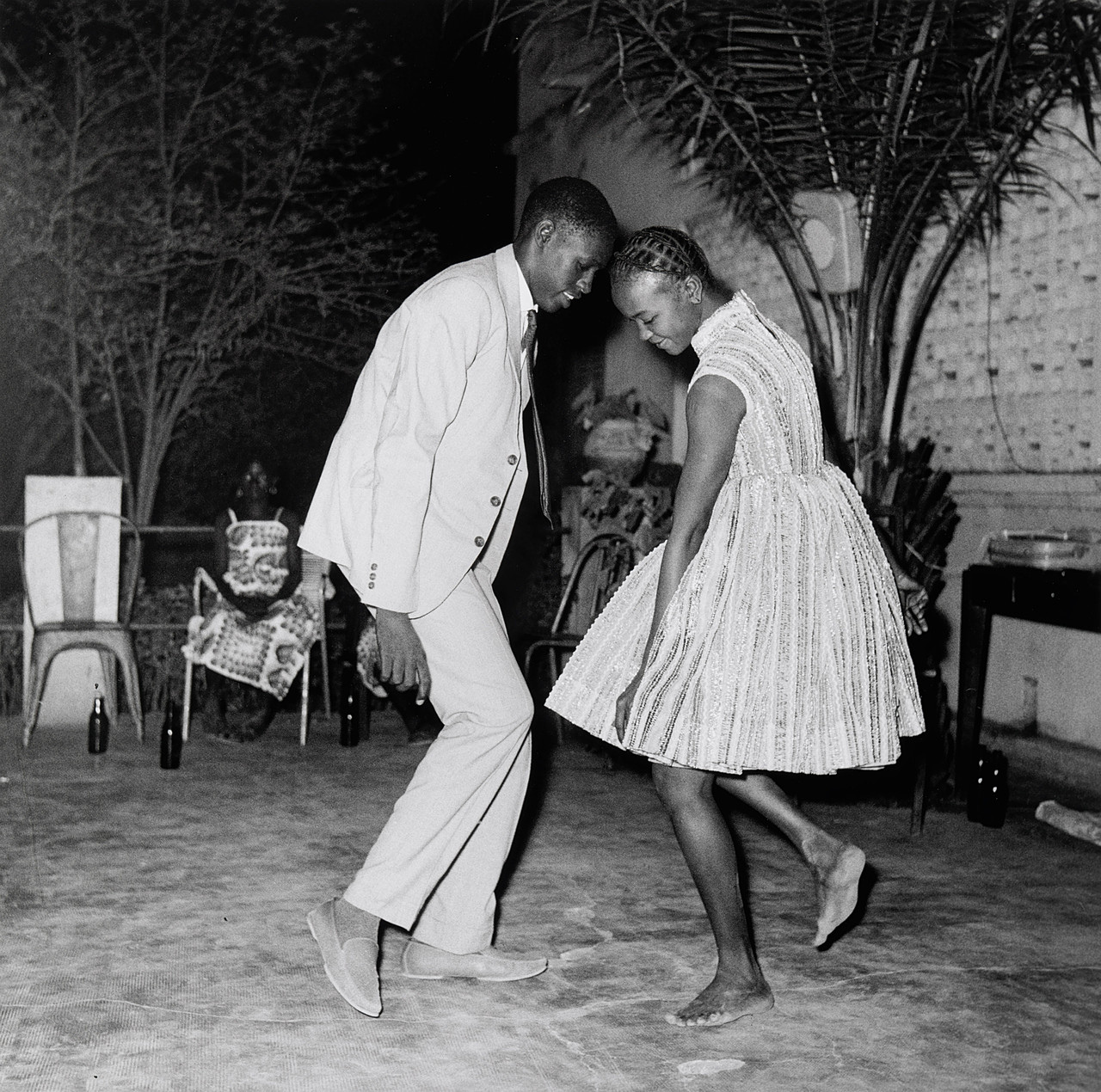
Nuit de Noël, 1963 - © Malick Sidibé Estate / Jack Shainman Gallery
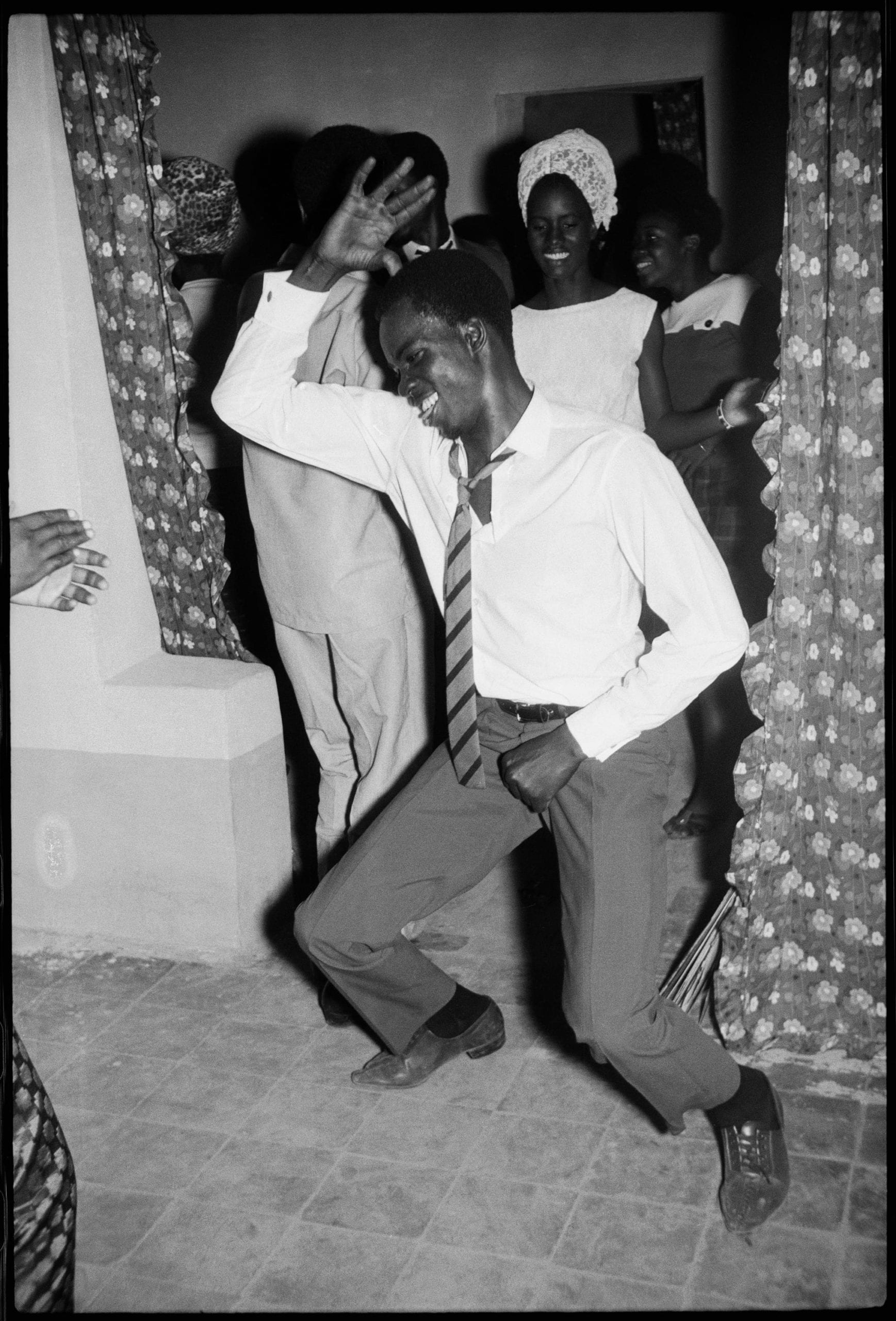
Malick Sidibé, Danseur Méringué, 1964 - © Malick Sidibé Estate / Jack Shainman Gallery
Painted Frames — Legacy in Colour
Toward the end of his life, Sidibé worked together with local Malian artisans on something quietly remarkable. His portraits were paired with vivid, hand-painted frames: not just decoration, but objects with real meaning. Keepsakes and symbols of pride, passed between people, cherished and shared. They reflect the joy and self-expression of his subjects, and remind us that his photography was always about community first.
Painted Frames, published after his passing by Loose Joints, brings this part of his practice into full view. It is a fitting final chapter: a photographer who always saw the image as a gift, making that idea literal in his last collaboration.
The frames are joyful. They are also a statement. A reclaiming of African visual culture in full colour, showing that black and white was always a technical choice, never a reflection of limited spirit.
© Malick Sidibé Estate / Loose Joints
Recognition Without Erasure
In 2007, Sidibé received a Golden Lion for Lifetime Achievement at the Venice Biennale, becoming both the first photographer and the first African to receive this honour. More recognition followed: the Hasselblad Award, the ICP Infinity Award, and his work entered the collections of MoMA, the Fondation Cartier and the Studio Museum in Harlem.
What matters most, though, is that none of this changed what the work was. It stayed rooted in Bamako, in the community, in the everyday lives of people living freely and beautifully in a place they called home. The recognition pointed outward. The photographs always pointed back.
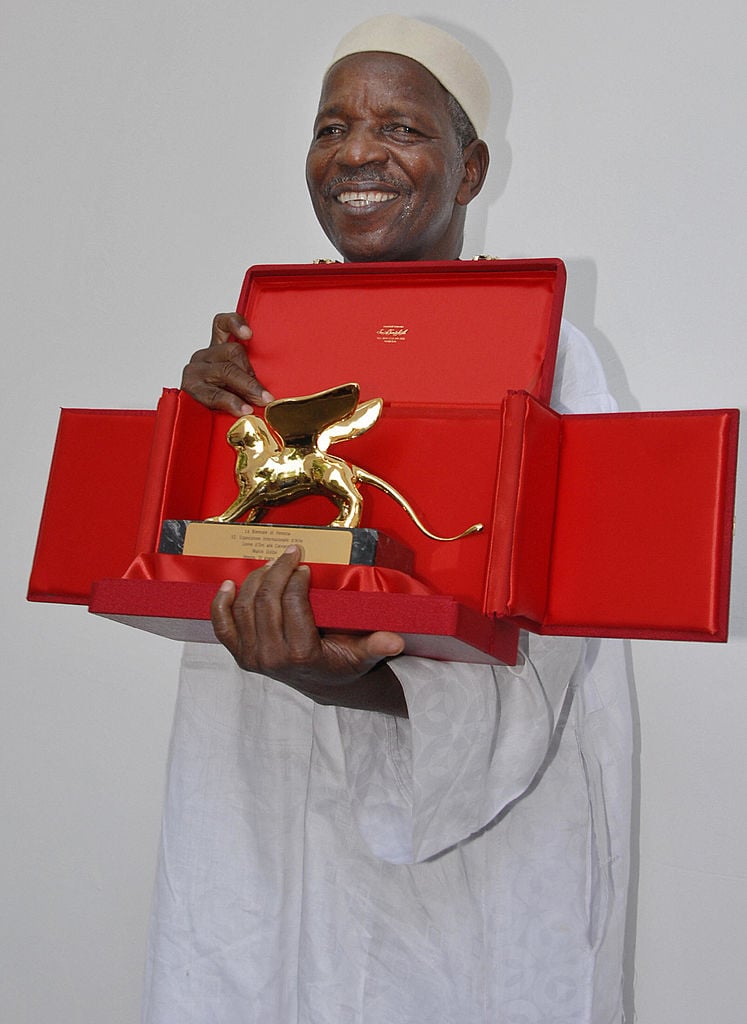
Malick Sidibé poses with his lifetime achievement award Golden Lion (Leone d’oro) during the 52nd Venice Biennale, Italy. - © Sebastiano Casellati
Reflection
Malick Sidibé reminds us that documenting people can be an act of devotion. That a camera, in the right hands, becomes a way of saying: you are worth preserving. Your style, your joy, your gathering in the dark with music playing, all of it matters.
In the West African tradition, the griot or jali is the keeper of shared memory. A storyteller, historian and witness, trusted with carrying the life of a community forward through time. Sidibé was exactly that, with a camera. Not an outsider looking in, but someone fully part of Bamako life, preserving what others might have let disappear. His archive is not simply a photographer's portfolio. It is a collective story told in light.
The things we wear are not just aesthetic choices but declarations: of where we come from, what we celebrate, who we are becoming. Sidibé understood this naturally. Every portrait in his archive is also, quietly, a portrait of self-determination. A whole generation made visible, not through an outside gaze, but by someone already inside the room, already part of the celebration, already one of them.
His images do not belong to the past. They belong to anyone willing to look slowly.

© Malick Sidibé Estate / Jack Shainman Gallery
Discover More
Step into the world Malick Sidibé:
Painted Frames, Loose Joints
Jack Shainman Gallery
Artnet
Take your time with the images. These are not documents of a distant era but an invitation to look at presence, pride and style as forms of quiet, powerful self-expression.


